Showing posts with label bird deterrents. Show all posts

Tuesday, April 24, 2012

How to Keep Swallows Away from Your Home

Get rid of swallows with swallow bird control products

by Alex A. Kecskes

Variously known as martins, mud swallows, cliff swallows or barn swallows, these slender, colorful birds are small--just five to eight inches long--yet they often create a big nuisance for homeowners. Only proven effective bird deterrents will keep them away.

More than half a dozen swallow species roam North America. They prefer the safety and security of lofty areas and will build their mud nests under overhangs, beams, window jams and the ledges of homes. They’ll also attach their nests to garages, patio covers, fixed awnings and gazebos—particularly on textured surfaces like rough-sawn wood, stucco, masonry and concrete. They look for mud and drinking water and will mix sand, grasses, hair and feathers with mud to build their vertical clusters of gourd shaped nests. To keep them away from your home, you’ll need an effective bird deterrent strategy.

If you have swallows around your home, you’ll no doubt have encountered mud nests, debris and bird droppings. Like many bird droppings, swallow droppings can carry any of 60 known diseases. Fallen swallow nests can easily be picked up by a curious pet or child.
You may be tempted to remove swallow nests but the birds are classified as migratory and insectivorous under the Migratory Bird Treaty Act of 1918. Swallows are also protected by state regulations, which means you can be fined if you harm them or disturb their nests. The point is, once swallows have staked claim to your home, you’ll have to wait until they leave to remove the nests. And scrapping off mud nests can permanently mar your siding or paint.
Obviously, the strategy to employ is to discourage them from building nests on your property in the first place. And one of the most effective ways to keep swallows away is through the use of Sonic Bird Deterrents.

Sonic bird deterrents use a swallow’s natural fear of predators. They generate distress and predator calls that make swallows too nervous to build nests. One commercially available system can repeat these calls every 10 minutes. Not to worry, the sounds merely resemble natural birdcalls to humans. Unlike other bird sonic devices whose high-pitched ultrasonic noises irritate pets, the best sonic units won't bother pets. You can set these units’ volume control to generate from 65-105 decibels, and you can program them to turn on or off at night.

The best sound bird deterrents come with a built-in speaker that protects up to an acre of your property. You can add more speakers to protect larger areas (up to 5 full acres). The best bird sonic units are ruggedly constructed with U.V. protected materials to survive harsh sun weather conditions.

For best results, bird sonic units should be installed as close as possible to where swallows normally gather and build their nests. For homeowners that means under eaves, patio covers, gazebos and fixed awnings.

Monday, January 16, 2012

Prepare Now - Before Swallow Nesting Season

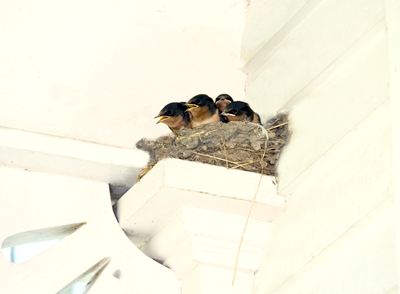
Baby-barn-swallows

by Terra Anders

Hirundo rustica!  It sounds like a battle cry of a foreign militia group. Actually, it is the scientific name for the common barn swallow.  Recognized by its long forked tail, glistening blue top feathers and soft pink breast color, the swallow can be seen flitting about almost endlessly throughout North America. One of the swallow’s most popular spots is California in the spring and summer.

Although these birds are pleasant to watch, they can create a nuisance in homes, structures, barns or stables.  Anywhere there are birds there is bird droppings.  In the case of swallows, their unique nesting habits add the additional title of pest bird.  Of the seven species of swallows that breed in California, the cliff and barn swallows build mud nests on the sides of homes, barns, garden gazebos, or stables.  These annoying mud nests often have landowners wondering how to keep these pest birds off their property.

Swallows look for structures that satisfy their four basic needs: an open area for seeking food, clean water for drinking and bathing, a vertical surface sheltered by an overhang for protection and attaching their nest, and, of course, enough good quality mud with which to build their mud nest. Once the birds find this perfect spot, they will come back year after year. 

The mud nests, just like the bird droppings can become infested with bugs or disease that can affect human health.  It is important to find humane ways to eliminate the nests and prevent the pest birds from returning the next year. During September and through January the swallows are still vacationing in South America, so now is the best time to install bird deterrents. Simply removing the abandoned nest will not deter these pest birds from returning.  In fact, removing nests during their “official” nesting season (mid-February to September 1) is not permitted in California without a special permit.

To keep pest birds away from a previously occupied nesting area, bird exclusion methods are required. Once the nest is removed and the area clean from debris, feathers and mud, use the methods suggested below to create a space that is uncomfortable and uninviting.  Bird Slopes under overhangs prevent the birds from getting a foothold on the vertical surfaces.  The UV protected slopes are a slippery, steeply slanted physical bird deterrent that blocks the overhang of the building.  These are ideal for ledges /overhangs that are about six inches wide. They are set in position and held in place with exterior polyurethane adhesive.

Hanging No Nasty Nest strips under eaves or overhangs are another effective way to keep birds away from the underside of overhangs or ledges. These are 3” x 11” strips of plastic that have a cluster of clear nylon strings dangling down.  Applying these irritating ticklers where the old nests used to be (or where new nests might be built) will coax pest birds to look elsewhere.

These simple bird control methods are aesthetically appealing and can be easily installed by the homeowner using adhesive, glue or nails. 

Thursday, March 17, 2011

Home Owners - Prepare now for the Swallows Invation

Spring is just around the corner and so is the arrival of Swallows. They'll be looking your home over for nesting and roosting spots. Yes, they're beautiful birds, but what they can do to your home and yard is not so pretty.

They'll be building their mud nests on your garage, gazebo, patio and home.  In fact, the eave of your home offers the perfect nest-building spot for swallows. It protects them from predators and it offers shelter from the elements.  So unless you've prepared your property properly with the right bird deterrents, you'll be plagued with swallow nests, the mess and debris.

Swallows prefer to nest in colonies, causing major headaches and thousands of dollars in damage for homeowners. And it's not just the nests; swallow droppings are unsightly and hazardous, carrying diseases that can be transmitted to humans.  When swallow nests eventually fall to the ground, the bugs, fleas, ticks and mites harboring inside can spread to dogs, cats and children who may pick them up.

Before you whip out the BB gun or bird poison, you should know that in the United States, all swallows are classified as migratory insectivorous birds under the Migratory Bird Treaty Act of 1918.  The birds are also protected by state regulations.  Once the birds have begun to construct their nests, it's too late to get rid of them. Disturb their nests or injure them at this point and you'll pay a fine for your folly.

The secret to avoiding the "swallows problem" is to take action before they arrive. That means using effective non-lethal bird deterrents designed to discourage them from calling your house a home.

Keep in mind that swallows will usually build their nests in a shady area under the eaves of a home, in a gazebo or patio cover, or any other area with right angles to the walls.  Another point to remember is that swallows will often build their nests against a textured surface where mud will stick more easily—surfaces like rough-sawn wood, stucco, masonry and concrete.

Once swallows have settled in to build their nests, it's virtually impossible to get rid of them.  Hosing down the nests won't discourage them; they'll just keep re-building their nests if they like your particular eave, garage, patio or gazebo.
So what are some ways to discourage swallows from invading your property?

Here are a few humane suggestions:
  • Plastic Bird Netting. Use a 3/4-inch mesh and hang it from the outer edge of the eave of your home down to the side of the wall creating a 45-degree angle. 
  • No Nasty Nest. Block birds from getting to potential nesting sites by installing No Nasty nest under your eaves. Birds will not want to wade through the hanging strings and will move on to a new spot.
  • Bird Slope. These slippery PVC panels create a smooth surface under the eave of your home that won't allow mud nests to "stick." Attach them under your eaves with adhesive.
Enhanced by Zemanta

Wednesday, February 2, 2011

How to Keep Swallows From Nesting Under Eaves

by Alex A. Kecskes
Swallows and other birds nesting in your eaves can create a number of problems for your home or commercial business. In preparing for the onslaught of pest birds for spring, you should know that many birds and their nests are protected by law. That means you can't remove the nests until after the birds have migrated or before they have finished building them.


As you can see, it's important to prepare for the arrival of pest birds before they construct their nests. Once they've settled in, you'll have to deal with a number of problems. For example, bird droppings can carry any of 60 known diseases–like salmonellosis. And droppings on walkways and entryways to your home or commercial building can create serious slip-and-fall hazards. (Wet bird poop can be as slippery as a tomato seed.)

When swallows migrate in spring, they quickly begin their search for textured surfaces to attach their mud nests. Keeping nests from being built on the eaves of your house or commercial property can be accomplished by denying the birds access before they begin building. This is often referred to as the "bird exclusion" method.

One popular and highly effective exclusionary bird-proofing device is the Bird Slope. Ideal for use on eaves, ledges, beams and similar areas frequented by birds, they are easily installed and quite effective against all types of birds.

The sloped panels typically come in 4-foot lengths. These are easily screwed, glued or nailed to most any flat surface. The best bird slope features a "snap on" extender, which makes it easy to adapt to ledges as wide as 10 inches. You can also get mounting clips  to install the slopes vertically on the sides of buildings. Some slopes come with “end caps” to keep birds from getting behind the slope. The base of a typical bird slope is 2–3/4-inches wide, which makes the panel easy to glue down with an outdoor polyurethane adhesive. Bird slope panels come in two colors--stone and grey to better blend in with your building's color palette. The best slope panels are made of U.V.-protected PVC and are more resistant to inclement weather.

To discourage swallows from nesting in eaves, you can install Bird Netting. This will deny the birds access to your eaves and they will simply go elsewhere to nest. Be sure to get enough netting to stretch from the outer edge of the roof to the side of the house. And make sure you get the right mesh size for swallows--1/4- to 1/2-inch mesh. Install the netting--using tape, staple-gun or hooks--so it extends from your roof's edge to the wall to completely block access to the eaves.

Keep in mind that the best time to install any bird proofing is now—before pest birds arrive and stake a claim to your eaves.
Enhanced by Zemanta